Climate · Nov 16, 2026 · Covered by 17 outlets in 13 countries
Record-hot Pacific: what the 2026 super El Niño means for food, shipping and your portfolio
NOAA's raw data show the Pacific +2.46°C above normal for Aug–Oct — the highest ever for that season. Cocoa is up 42% and rice 50% since El Niño was declared; history says the biggest economic damage comes next year.
한국어로 보기 →What happened
- The Paraná exceeded evacuation level in Santa Fe; more than 200 people sheltered (El Litoral).
- Santa Maria in Ilocos Sur was placed under a state of calamity over drought-related crop losses (Inquirer).
- Ecuador's Guayas province has 283 people in shelters (El Comercio EC).
- The Guardian calls it the strongest El Niño in centuries, a 'risk multiplier' for COP31.
This El Niño in numbers
Why this El Niño is different
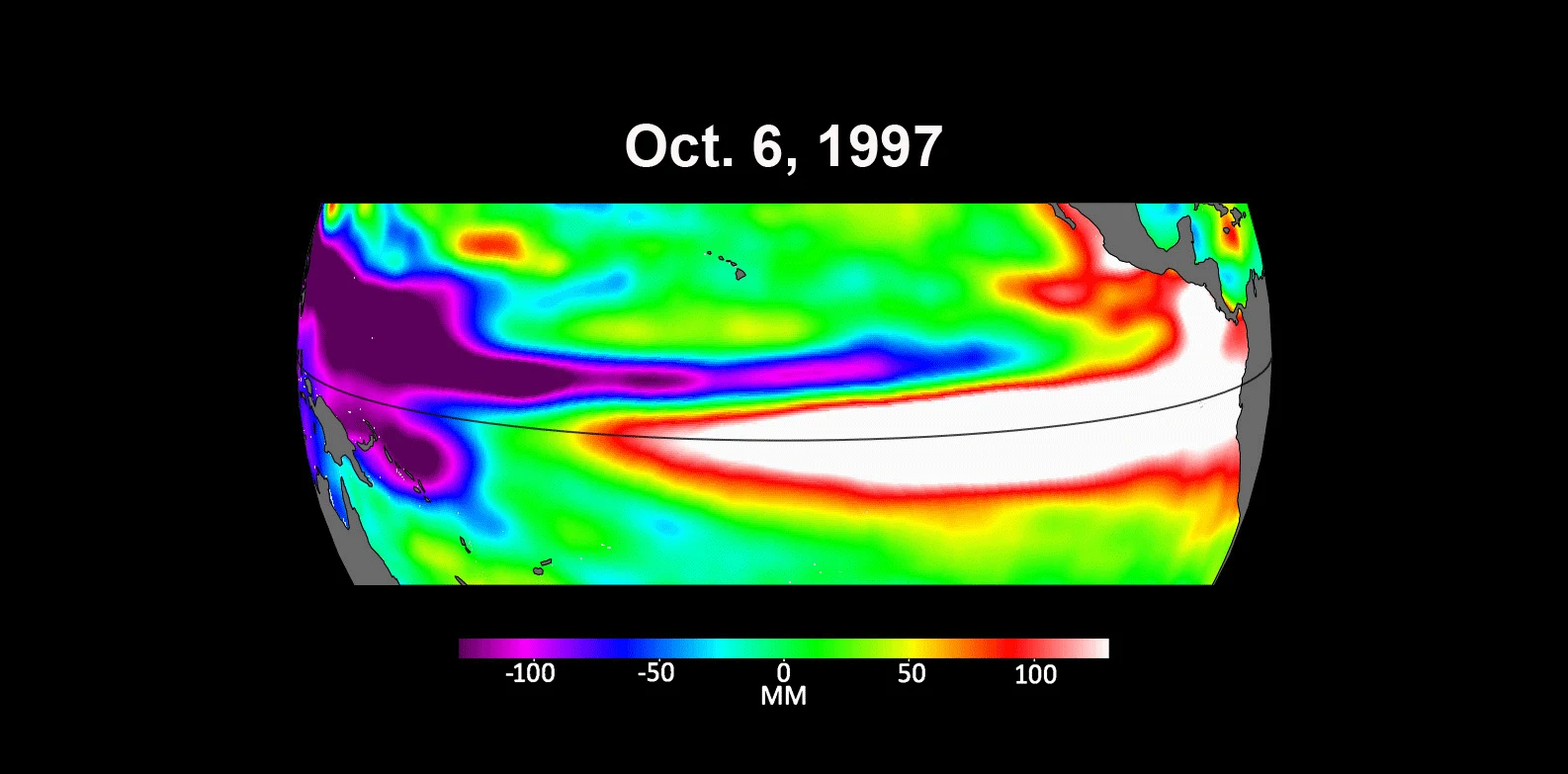
NOAA's raw index shows the central Pacific +2.46°C warmer than normal for August–October — higher than at the same point in 1997 or 2015, the two benchmark 'super' events. It has done so before the usual November–January peak.
Two caveats matter. NOAA now officially tracks a relative index (RONI) that subtracts global ocean warming; on that measure the reading is +2.0°C. And weekly data in November hint that heat below the surface may be levelling off. 'Record' is likely, not certain.
2026 has not peaked yet — El Niños usually peak in Nov–Jan.
Source: NOAA CPC oni.ascii.txt (raw data, downloaded 2026-11-16)
On NOAA's new official relative index (RONI) the same period reads +2.0°C.
Source: NOAA CPC oni.ascii.txt; CPC weekly update (Nov 9) via watchers.news
Coffee fell on a record 66.7m-bag Brazilian crop; palm oil's hit is expected mostly in 2027.
Source: Trading Economics; Invezz (Nov 13); Averin; GAPKI
How El Niño travels into the economy
El Niño is not one shock but a bundle of regional weather shocks that hit different markets at different times. The biggest price effects usually show up the following year, after harvests fail.
Seven transmission channels
Palm oil output ↓ (up to 3 Mt in Indonesia, mostly 2027)
↓Who feels itRamen, snacks, cooking oil, biodiesel
Rice & sugar supply ↓, export curbs risk
↓Who feels itAsian food inflation
Côte d'Ivoire cocoa crop −21–25% forecast
↓Who feels itChocolate & confectionery margins
Anchovy catch ↓ → fishmeal & fish-oil prices at records
↓Who feels itAquaculture feed; algae omega-3 makers gain
Canal draft limits → fewer containers per ship
↓Who feels itFreight rates, US–Asia trade times
Lower insurance claims; weaker gas heating demand
↓Who feels itUS insurers ↑, gas producers ↓
More LNG burned for power
↓Who feels itLNG exporters ↑
How past super El Niños played out
- 1982–83
Peak +2.14. Global income loss estimated at $4.1 trillion in the following years.
- 1997–98
Peak +2.37. Indonesian forest fires and regional haze, about 23,000 deaths worldwide, and an estimated $5.7 trillion income loss — on top of the Asian financial crisis.
- 2015–16
Peak +2.59, the record. 2016 became the hottest year measured at the time; southern Africa suffered severe drought and palm oil rallied the following year.
- 2023–24
Peak +1.99. Panama Canal transits were cut for months and cocoa topped $10,000 a tonne in 2024.
What it means for Korea
- Korea imports most of its grain (self-sufficiency around 25%), so global price spikes reach Korean shelves through import costs and the exchange rate.
- Analysts flag confectionery and beverage makers (cocoa, coffee, sugar) and ramen makers (palm oil) as the most cost-exposed; how much they can pass on to consumers decides the hit.
- Trading houses that own palm plantations in Indonesia are on the other side of the same trade.
- Weather: in past El Niño winters Korea has tended to be warmer with more precipitation than normal (Korea Meteorological Administration analysis).
Likely winners and losers — with valuations
Likely to benefit
| Price | Mkt cap | P/E | Fwd P/E | 52-wk position | Target (upside) | Analysts | |
|---|---|---|---|---|---|---|---|
| CF Industries US Nitrogen fertilizer — analysts see it as the most price-responsive El Niño play (Scotia Capital). | $125.09 | 18.30B | 8.82 | 9.56 | 75% | 130.04 (+3.96%) | Hold |
| Nutrien CA World's largest crop-input supplier; benefits when farmers replant and prices rise. | $71.24 | 33.81B | 15.62 | 15.19 | 54% | 77.49 (+8.77%) | Buy |
| Allstate US El Niño suppresses Atlantic hurricanes → lower claims for US home insurers (Piper Sandler). | $267.64 | 66.23B | 6.05 | 9.29 | 85% | 277.23 (+3.58%) | Hold |
| Cheniere Energy US Largest US LNG exporter; drought-hit hydropower raises LNG demand. | $308.75 | 63.05B | 21.44 | 13.19 | 85% | 335.70 (+8.73%) | Buy |
| LX인터내셔널 KR Owns about 24,000 ha of palm plantations in Indonesia; higher palm prices lift the unit. | ₩34,850 | 1.25T | 8.16 | 4.46 | 18% | 58,833.33 (+68.82%) | Buy |
| 포스코인터내셔널 KR About 150,000 ha of palm land after the Sampoerna Agro deal; Indonesian palm unit's Q2 operating profit +92% y/y. | ₩49,850 | 8.50T | 10.26 | 8.48 | 11% | 87,400.00 (+75.33%) | Buy |
Under cost pressure
| Price | Mkt cap | P/E | Fwd P/E | 52-wk position | Target (upside) | Analysts | |
|---|---|---|---|---|---|---|---|
| Hershey US Cocoa is its key input; West African crop risk squeezes margins. | $174.27 | 35.02B | 19.72 | 18.82 | 22% | 180.90 (+3.8%) | Hold |
| Mondelez US Global chocolate & biscuits (Cadbury, Oreo) — cocoa and sugar exposed. | $67.54 | 85.49B | 21.25 | 20.01 | 93% | 70.45 (+4.31%) | Buy |
| 롯데웰푸드 KR Korea's largest confectioner; Q3 operating profit +30% but below consensus, cocoa costs absorbed with domestic price freeze. | ₩139,000 | 1.23T | 14.36 | 7.94 | 75% | 166,500.00 (+19.78%) | Strong Buy |
| 오리온 KR Chocolate pies & snacks; kept domestic prices frozen while cocoa rose. | ₩113,800 | 4.50T | 10.73 | 9.02 | 27% | 160,333.33 (+40.89%) | Strong Buy |
| 농심 KR Ramen maker — palm oil and wheat are major costs (sector view: LS Securities). | ₩361,000 | 2.11T | 11.09 | 10.34 | 26% | 500,437.50 (+38.63%) | Buy |
| CJ제일제당 KR Grains, sugar and feed inputs; exposed to Asian crop shocks. | ₩177,100 | 2.74T | n/a | 5.17 | 10% | 251,142.86 (+41.81%) | Buy |
| EQT US US natural-gas producer; a mild El Niño winter weakens heating demand (Truist). | $52.81 | 33.04B | 12.53 | 17.88 | 24% | 66.77 (+26.43%) | Buy |
AI valuation read
The two Korean trading houses with Indonesian palm plantations trade near the bottom of their 52-week ranges (11–18%), with analyst targets 69–75% above the price — the market is pricing other businesses (steel, energy, trading) far more than the palm-oil tailwind.
On the cost side, Mondelez sits near its 52-week high despite cocoa: investors trust its pricing power. Korean confectioners Orion and Nongshim sit in the lower third, reflecting price freezes at home.
US insurers and LNG exporters are already near 52-week highs — much of the El Niño benefit appears priced in.
Prices at close Nov 13, 2026 (stockanalysis.com) · Company lists show exposure to El Niño channels reported by analysts and media — not investment advice. Valuation metrics are third-party data as of the date shown.
Scenarios ahead
Peak in Nov–Jan near or above the record, then weakening by spring 2027. Food inflation pressure in Asia through H1 2027; palm oil supply hit lands in 2027.
India restricts rice exports again → global rice prices up to 30% higher; sugar keeps rising (FAO sugar index already at its highest since Nov 2024).
Strong El Niños are often followed by La Niña (as after 1998 and 2016), which would reverse several of these trades in late 2027.
Sources (raw data, reporting, research)
- NOAA CPC — Oceanic Niño Index raw data (oni.ascii.txt)
- NOAA CPC — ENSO diagnostic discussion (October 2026)
- Watchers — El Niño 2026: RONI 2.0, behind 1997 record forecast (Nov 10)
- Invezz — What is El Niño and why is the world so worried? (Nov 13)
- Trading Economics — Cocoa
- Averin — Super El Niño 2026: food commodities
- Allianz Research — Super El Niño risk (July 2026)
- Wikifarmer — FAO Food Price Index, October 2026
- Panama Canal reduces Neopanamax draft to 47.5 ft
- ScienceDaily — El Niño's persistent effect on global economic growth (Callahan & Mankin)
- Investing.com — El Niño stock plays: winners and losers
- Fortune — A stock trader's guide to a rare 'Super El Niño'
- 뉴스핌 — 인플레 새 복병 '슈퍼 엘니뇨'…투자 대응법
- 헤럴드경제 — 포스코인터, 삼푸르나 아그로 인수 완료
- 머니투데이 — 팜유·망고·김까지 판다…K상사 식량사업
- 딜사이트 — 롯데웰푸드 3분기
- stockanalysis.com — company valuation data (prices as of Nov 13, 2026)
Updated: 2026-11-16
How the world is covering it
- MX El Financiero — ‘El Niño’ pone en alerta al Pacífico y amenaza con subir el nivel del mar: ¿Qué son las ondas Kelvin?
- ZA IOL — Inside the 2026 El Niño: Why extreme weather is spiking global heat and grocery bills
- PH Philippine Daily Inquirer — Super El Niño puts Ilocos Sur town under state of calamity
- CO El Espectador — ¿Por qué puede subir la luz con el fenómeno de El Niño? Así se calculan las tarifas
- FR Le Monde — Confrontée à un El Niño historique, l’Amazonie brésilienne en état d’urgence environnemental
- PE Infobae Perú — SUNAT posterga hasta abril de 2027 cuotas del ITAN para pesca y textiles afectados por El Niño
- AR Clarín — Súper Niño 2026 en Argentina, EN VIVO: cuándo llegará el pico de lluvias y cuáles serán las provincias más afectadas
- EC El Comercio EC — 283 personas permanecen en albergues de Guayas por los efectos de El Niño
- EC El Universo — El Niño en arroz y cacao
- EC Primicias — Cocodrilos, nutrias, boas y piqueros, las especies que 'aparecen' en Guayaquil con El Niño
- GB The Guardian — ‘Risk multiplier’: super El Niño looms over Cop31 as climate pattern fuels global disasters
- GH MyJoyOnline — El Niño: West African governments urged to prepare for food and health threats
What to watch
Watch peak-rain forecasts for South America and food-price indices.